Narrating the Stories That Matter
Flash Fiction
The POSSIBLE EFFECTS flash-fiction series explores how small human choices create emotional, social, and planetary consequences over time.
Each story is a cinematic glimpse into ordinary lives shaped by desire, ambition, habit, love, memory, cities, nature, and the quiet pressure of the future.
These are not warnings from a distance. They are intimate moments where people meet the consequences of their own choices — and face the possibility of changing the next one.
Set across different countries, cities, and cultural landscapes, the series brings together characters from many walks of life, each confronting the visible and invisible effects of how we live.
Explore the stories as the POSSIBLE EFFECTS world continues to grow.
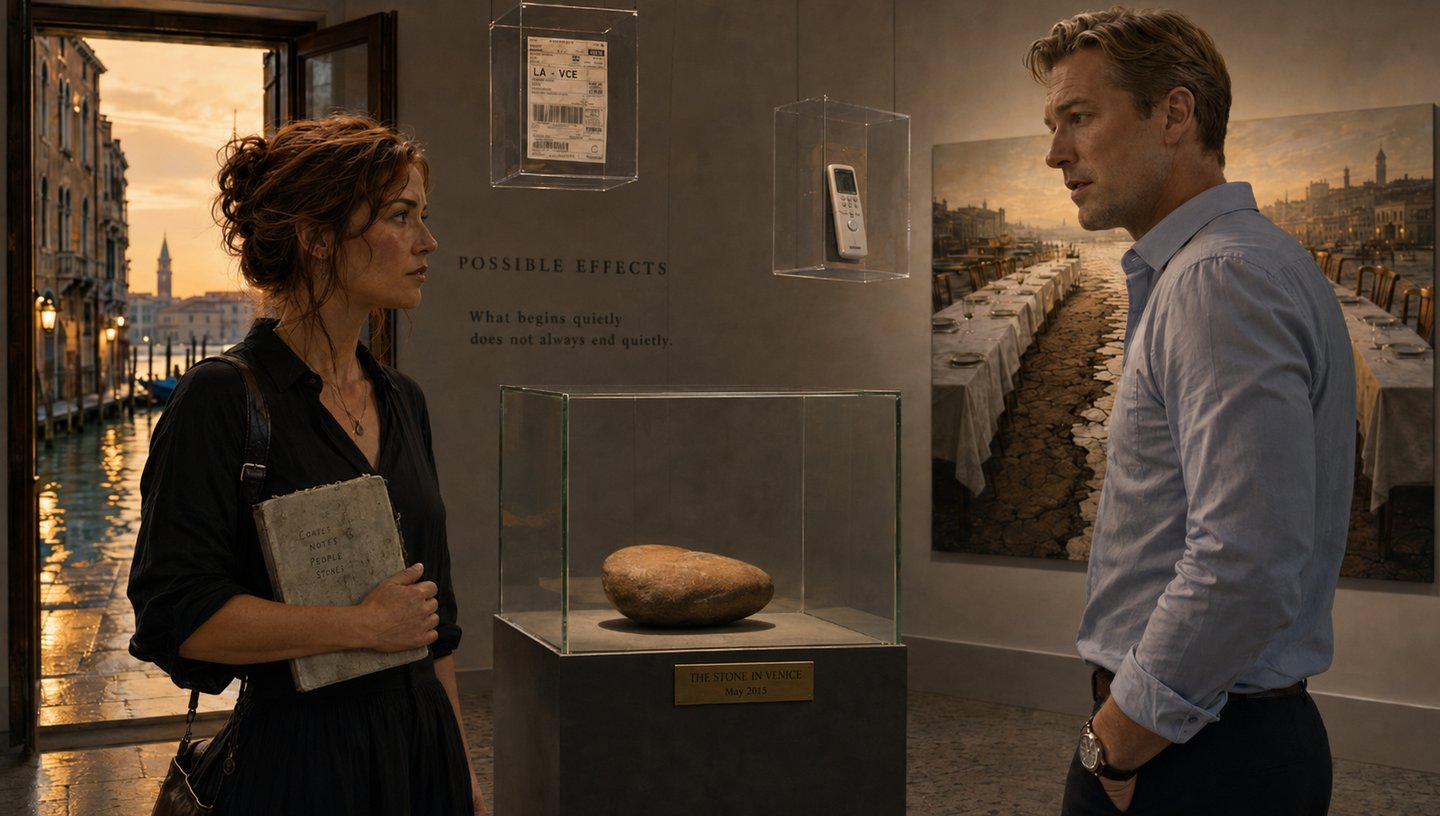
The Stone in Venice
Venice, May 2015
Mara Bell distrusted any room where suffering looked beautiful.
That was her first thought when she stepped into the small exhibition space on Via Giuseppe Garibaldi, away from the polished noise of the Venice Biennale season. Outside, Venice glittered with water, linen, invitations, and people who handled crises like material. Inside, the air was cool, dim, and almost too still.
Her black dress was creased from the overnight train. Her hair, copper-brown and badly pinned, had loosened in the lagoon humidity. One corner of her field notebook was swollen from rainwater in New Orleans. She carried herself like a woman who had spent years standing in public meetings beside maps of places already half-lost.
She had one free afternoon before flying back to Louisiana.
She had wanted beauty without responsibility.
Then she saw the stone.
It sat alone in a glass case. No pedestal. No drama. Just a dry brown river stone, split along one side like a mouth that had forgotten water.
The brass plate beneath it read:
1 stone × one village × ten failed seasons.
Mara stopped breathing for half a second.
She knew that silence. In the coastal parishes south of New Orleans, families spoke of vanished roads and drowned yards with the strange politeness people use around the dead. Her grandmother had once pointed across open water and said, “There used to be a church there,” as if memory could still stand where land could not.
A man beside her said, “Beautifully staged.”
Mara turned.
He was tall, fair, cleanly dressed, and almost offensively composed. His pale blue shirt looked as if it had never touched sweat. His watch was quiet but expensive. His shoes had the clean arrogance of airport lounges and private cars. He was not looking at the stone with grief. He was looking at it as a structure.
“Beautiful?” Mara asked.
He heard the blade.
“I meant the restraint,” he said. “The artist doesn’t overstate.”
“Some things don’t need help becoming unbearable.”
He looked at her properly then.
His eyes were gray, tired, intelligent. His face was controlled, but something moved beneath it — irritation first, then interest.
For a moment, neither apologized.
On the entrance wall, black letters announced:
POSSIBLE EFFECTS
Manohar Chiluveru
What begins quietly does not always end quietly.
Mara had left a coastal-risk panel that morning after two days of charts, pledges, translation headsets, and men in dark suits asking whether displacement could become a resilience model. She had watched them nod gravely while drinking sparkling water beside windows that opened toward the lagoon.
She was thirty-six, a coastal displacement researcher from New Orleans, and her life had narrowed into flood maps, insurance files, relocation meetings, saltwater lines, family interviews, and photographs of porches where nobody sat anymore.
The man moved with her into the next room, not quite following, not quite leaving.
Suspended in clear boxes were ordinary objects: a phone charger, a fast-fashion receipt, an air-conditioning remote, a shipping label, a child’s broken yellow toy.
Each had its own equation.
1 receipt × 40 million orders × 6 seasons.
1 remote × 12 hours cooling × one sealed room.
1 shipping label × three oceans × invisible fuel.
The man stopped at the label.
Mara noticed his jaw tighten.
“You work with shipping,” she said.
He smiled once, without pleasure. “Is it that visible?”
“No. You looked guilty before you looked interested.”
That startled a real laugh out of him. It vanished quickly.
“Elias Wren,” he said. “Oslo. Rotterdam when necessary. Singapore, when punished.”
“Mara Bell. New Orleans. Parish halls are punished. Flood zones when necessary.”
“That sounds more honest than my work.”
“That depends on what your work does.”
He slid his hands into his pockets, a man trained to look relaxed when cornered. “I help logistics companies move goods faster.”
“And cheaper.”
“Yes.”
“And more often.”
His smile disappeared.
From somewhere above them, a recorded voice entered the room, calm enough to sound innocent.
“An effect is rarely born at the moment of disaster. It is assembled earlier, in comfort, repetition, and permission.”
Elias looked up at the ceiling as if the voice had personally accused him.
Mara almost smiled.
“Too dramatic?” she asked.
“Too accurate.”
They entered the final room together.
A large painting stood at the center, taller than both of them. A dining table stretched across the canvas. At first, it seemed ordinary — plates, glasses, folded napkins, a vase of white flowers. Then the table split into a dry riverbed. The glasses held dust. The flowers were painted so delicately that their death looked expensive.
The title was written on the wall:
The Last Comfortable Day
Mara felt the pull low in her chest. Not grief exactly. Recognition.
Her phone vibrated.
She ignored it.
It vibrated again.
She stepped aside and answered. A community meeting near Isle de Jean Charles had been postponed again. The officials wanted cleaner numbers before approving support. Something concise. Something that could fit inside a briefing folder. Not family histories. Not cemetery maps. Not the names of people who had already moved three times and still kept the same rusted keys.
Mara listened. Her face did not change. Only her fingers tightened around the phone until her knuckles paled.
When she ended the call, Elias was pretending not to have heard.
“Bad news?” he asked.
“Ordinary news.”
“That sounds worse.”
“It usually is.”
He studied her then, and she disliked how carefully he did it. Men like him liked to understand things. Understanding allowed them to remain untouched.
Near the far wall, the artist stood with two visitors. Mara recognized him from the entrance image: Manohar Chiluveru, calm, dark-haired, listening more than speaking. He did not perform well. He stood near the wall, letting visitors look past him first.
Elias waited until the visitors moved away.
“May I ask you something?” he said.
Manohar nodded.
“Do you believe art changes behavior?”
The artist looked at Elias, then at Mara, then through the doorway at the dry stone in the glass case.
“Not always,” he said. “But sometimes it reaches one person before the next decision.”
He did not explain further.
That was the force of it.
Outside, evening lowered itself over Venice in gold sheets. Children kicked a ball near a bakery. A woman shook a rug from a balcony. Tourists lifted their phones toward the water, already holding too many reflections.
Mara walked fast. Elias kept pace.
For a while, they let the city speak: footsteps on stone, boat engines, cutlery from open windows, gulls crying like bad news.
Then Elias said, “I have a contract waiting.”
She did not ask. She knew confession when it wanted permission.
He told her anyway. A fashion company. New shipping routes. Faster delivery. Lower fuel per shipment, but higher volume overall. Efficiency with damage folded inside.
Mara watched a paper cup turn slowly in the canal.
“You want me to tell you not to take it,” she said.
“No.”
“You want me to tell you it doesn’t matter.”
He was silent long enough to make the answer visible.
A church bell rang somewhere behind them.
Mara turned to him. “I have spent twelve years trying to convince people that slow loss is still loss. Do you know what they always want?”
“What?”
“A photograph. A ruined house. A flooded street. An old woman is crying beside the water. Proof that damage has become dramatic enough to fund.”
Elias looked away.
His face had changed. The smoothness had cracked.
“You think I don’t know that?” he said.
“I think you know,” she said. “That’s worse.”
The words landed harder than she expected.
For a second, she wanted to take them back. That was her flaw: she could turn truth into a weapon and call it clarity.
Elias breathed out slowly. “And you?”
“What about me?”
“You catalog grief so precisely you never have to feel it.”
Now she looked away.
The canal between them darkened.
They ate later at a small counter where neither knew how to order properly. He mispronounced the name of a dish. She corrected him too sharply. He accepted the correction with a small bow that made her laugh despite herself.
The laugh surprised both of them.
Their shoulders almost touched. Once, when she reached for a napkin, his hand moved at the same time. Their fingers brushed. Barely.
It should have been nothing.
It was nothing.
At the edge of the lagoon, the wind lifted loose strands of hair across her cheek. Elias reached as if to move them, then stopped himself.
“You make it sound as if every choice is a crime,” he said.
“No,” she said. “Only every ignored effect.”
He looked at her for a long time.
She wanted him to argue. She wanted him to leave. She wanted him to understand without needing anything from her.
None of those things happened.
The next morning, Mara returned to the exhibition before her flight.
She told herself she wanted to see the stone once more.
Elias was already there.
He stood before the shipping label, holding his phone. His shirt was still clean, but the man inside it was not. He looked as if sleep had refused to protect him.
“I didn’t sign,” he said.
Mara felt relief, then distrusted it. Relief was dangerous. It made a single act look like redemption.
“That may cost you,” she said.
“Yes.”
“Will it change anything?”
He looked at the label, then at her. “Not enough.”
It was the first fully honest thing he had said.
Mara opened her notebook. Inside were sketches from dawn: tide lines, church sites, family names, boat routes, old burial grounds, raised roads, possible relocation paths, places where maps had stopped telling the truth. Her handwriting was messy. The plan was not elegant. But it breathed.
“I stopped trying to make numbers do the whole work,” she said.
Elias studied the page. “You need movement.”
“I need many things.”
“I know movement.”
She almost laughed at the smallness of it.
Then she remembered the stone.
The ordinary dry stone that had crossed water and distance to sit in a glass case in Venice, accusing no one, excusing no one.
At the exit, the wall lit as they approached.
You did not do this. You are doing this.
Mara read it differently the second time.
Outside, her flight would leave soon. His meeting would begin without him. Venice glittered as if nothing were wrong, which was its most dangerous talent.
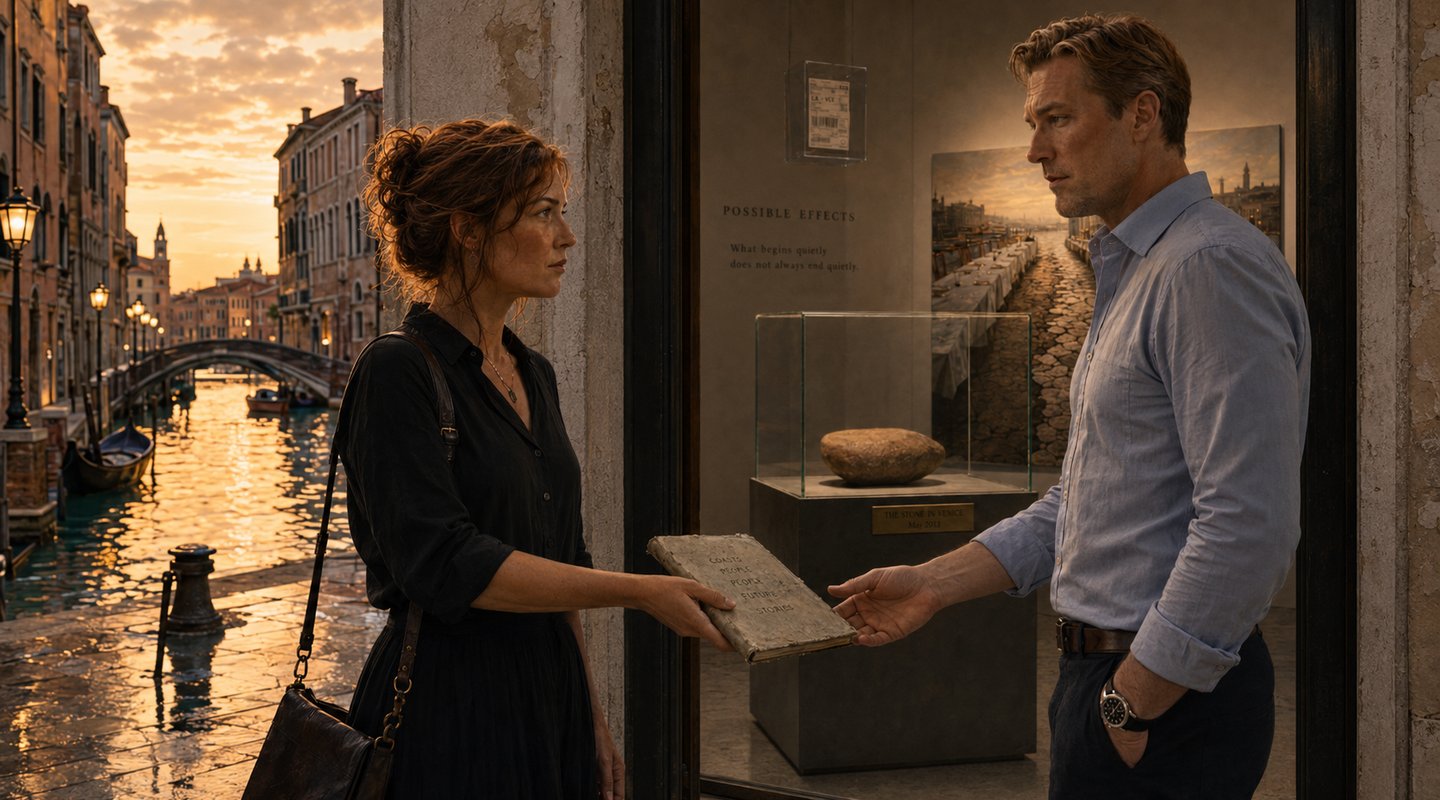
Elias held out his hand.
Not for romance. Not yet.
For the notebook.
Mara gave it to him.
Their fingers touched again, longer than necessary, shorter than courage.
“Send me what needs to move,” he said.
She looked at him, then through the window at the stone.
“One community first,” she said.
“One community,” he said. “Then we see what follows.”
Mara stepped into the Venetian light.
Behind the glass, the stone remained dry.
Outside, Venice shone as if water had forgiven everyone.